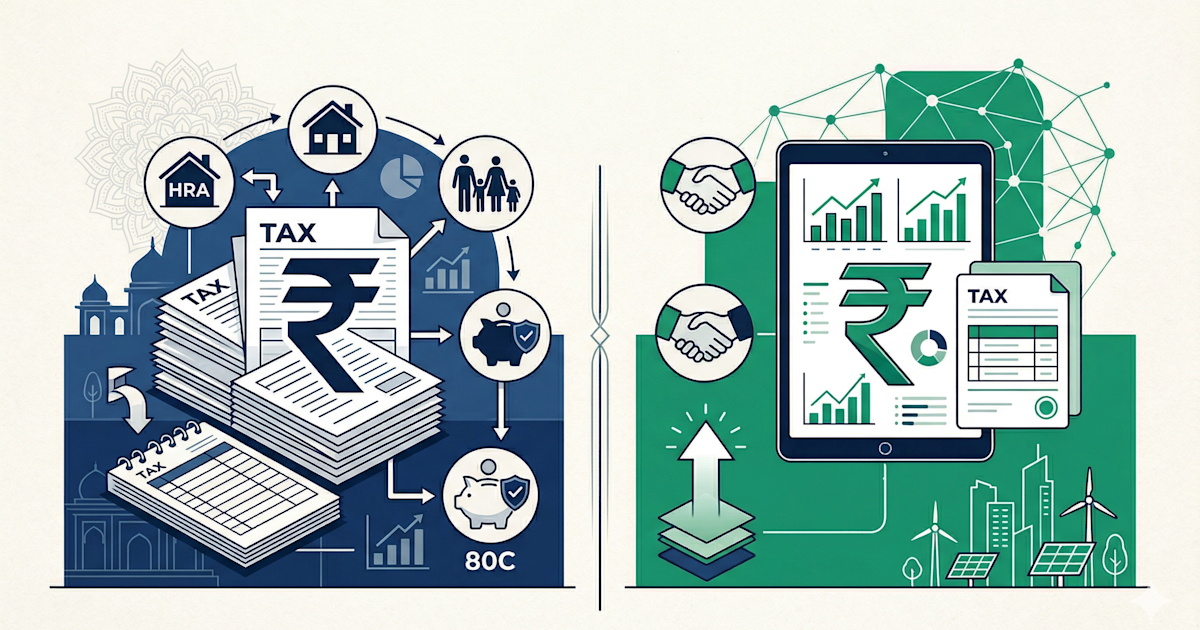
Every salaried employee in India has to make this choice at the start of the financial year. New Regime or Old Regime? The answer is not the same for everyone. It depends on your CTC, your investments, and whether you have a home loan or pay rent.
This guide gives you the complete picture for FY 2026-27 so you can make the right call in under 5 minutes.
What Changed in FY 2026-27
The New Tax Regime became significantly more attractive this year. The zero-tax threshold was raised to Rs. 12 lakh through the Section 87A rebate. If your taxable income after the Rs. 75,000 standard deduction is Rs. 12 lakh or below, you pay zero income tax.
This single change made the New Regime the default winner for most salaried employees earning below Rs. 15.75 lakh CTC.
New Tax Regime Slabs FY 2026-27
Income Slab | Tax Rate |
Up to Rs. 4,00,000 | Nil |
Rs. 4,00,001 to Rs. 8,00,000 | 5% |
Rs. 8,00,001 to Rs. 12,00,000 | 10% |
Rs. 12,00,001 to Rs. 16,00,000 | 15% |
Rs. 16,00,001 to Rs. 20,00,000 | 20% |
Rs. 20,00,001 to Rs. 24,00,000 | 25% |
Above Rs. 24,00,000 | 30% |
Standard deduction of Rs. 75,000 applies automatically. Section 87A rebate eliminates tax entirely if taxable income is Rs. 12 lakh or below. No other deductions or exemptions are allowed under this regime.
Old Tax Regime Slabs FY 2026-27
Income Slab | Tax Rate |
Up to Rs. 2,50,000 | Nil |
Rs. 2,50,001 to Rs. 5,00,000 | 5% |
Rs. 5,00,001 to Rs. 10,00,000 | 20% |
Above Rs. 10,00,000 | 30% |
Standard deduction of Rs. 50,000 applies. You can also claim 80C up to Rs. 1.5 lakh, HRA exemption, 80D health insurance up to Rs. 25,000, NPS deduction of Rs. 50,000 under 80CCD(1B), and home loan interest up to Rs. 2 lakh under Section 24b.
Side by Side Tax Comparison
Here is what you actually pay under each regime at different CTC levels, assuming a standard salary structure and no deductions claimed under the Old Regime beyond the standard deduction:
Annual CTC | New Regime Tax | Old Regime Tax |
Rs. 8 LPA | Rs. 0 | Rs. 54,600 |
Rs. 10 LPA | Rs. 0 | Rs. 1,17,000 |
Rs. 12 LPA | Rs. 0 | Rs. 1,56,000 |
Rs. 15 LPA | Rs. 45,500 | Rs. 2,10,600 |
Rs. 20 LPA | Rs. 1,17,000 | Rs. 3,51,000 |
Rs. 30 LPA | Rs. 3,27,600 | Rs. 5,46,000 |
The New Regime wins at every level when you have no deductions. The Old Regime only catches up when your total claimable deductions are large enough to offset the difference.
Use the CTC to In-Hand Calculator to get your exact tax under both regimes based on your actual salary structure.
When New Regime Wins
The New Regime is better when your total claimable deductions under the Old Regime are below Rs. 3.75 lakh per year. This covers the majority of salaried employees, especially those:
Earning below Rs. 15.75 lakh CTC
Without a home loan
Without maximum 80C utilisation
Living with parents and not claiming HRA
For example, at Rs. 12 LPA under the New Regime you pay zero tax due to the 87A rebate. Under the Old Regime with Rs. 1.5 lakh in 80C investments, you would still pay around Rs. 23,400. New Regime wins clearly here.
When Old Regime Wins
The Old Regime saves more money when you have significant deductions stacking together. If you have all of the following, your total deductions can reach Rs. 3.75 lakh or more:
Home loan interest above Rs. 1.5 lakh per year under Section 24b
Full 80C utilisation of Rs. 1.5 lakh
NPS contribution of Rs. 50,000 under 80CCD(1B)
Health insurance premium of Rs. 25,000 under 80D
For a Rs. 25 LPA employee with all deductions maxed, the Old Regime can save Rs. 50,000 to Rs. 80,000 more per year. The standard deduction of Rs. 75,000 also plays a role in how much each regime saves you.
The Simple Decision Rule
Add up all deductions you can actually claim under the Old Regime: 80C investments, NPS contribution, home loan interest, HRA exemption, and health insurance premium.
If the total is below Rs. 3.75 lakh, choose the New Regime
If the total is above Rs. 3.75 lakh, calculate both regimes with your exact numbers
The break-even point shifts at higher income levels, so the calculator is more reliable than any rule of thumb above Rs. 20 LPA.
How to Switch Regimes
Salaried employees can switch between regimes every financial year. Submit your declaration to HR before April to ensure correct TDS deduction from month one. If you miss the deadline, your employer defaults to the New Regime. You can still choose either regime when filing your ITR independently of what was deducted during the year.
Frequently Asked Questions
Which tax regime is better for salaried employees in FY 2026-27?
The new tax regime is better for most salaried employees in FY 2026-27, especially those earning below Rs. 15.75 lakh CTC without a home loan. The zero-tax threshold of Rs. 12 lakh taxable income means most employees in this range pay significantly less tax under the new regime.
What is the tax-free limit under the new tax regime in FY 2026-27?
Under the new tax regime, taxable income up to Rs. 12 lakh attracts zero tax due to the Section 87A rebate. For salaried employees, the Rs. 75,000 standard deduction means a gross salary up to Rs. 12.75 lakh results in taxable income at or near the Rs. 12 lakh threshold. At exactly Rs. 12.75 lakh gross salary, the tax payable is Rs. 20,800 -- not zero. True zero-tax applies when gross salary is Rs. 12 lakh or below.
Can I switch between new and old tax regime every year?
Yes. Salaried employees can switch between the new and old tax regime every financial year. You declare your choice to your employer at the start of the year for TDS purposes. You can independently choose either regime when filing your ITR, regardless of what was deducted by your employer.
What deductions are allowed in the new tax regime?
The new tax regime allows very few deductions. The main ones are the Rs. 75,000 standard deduction, employer NPS contribution under Section 80CCD(2), and Agniveer corpus fund contributions. Deductions like 80C, HRA exemption, 80D, and home loan interest under Section 24b are not available in the new regime.
Is the old tax regime still worth it in FY 2026-27?
The old tax regime is worth it if your total claimable deductions exceed Rs. 3.75 lakh per year. This typically requires a home loan with interest above Rs. 1.5 lakh, full 80C utilisation, HRA exemption, and NPS or health insurance contributions combined.
What is the 30% tax slab income level in the new regime for FY 2026-27?
Under the new tax regime for FY 2026-27, income above Rs. 24 lakh is taxed at 30%. The slabs below that are: up to Rs. 4 lakh at nil, Rs. 4 to 8 lakh at 5%, Rs. 8 to 12 lakh at 10%, Rs. 12 to 16 lakh at 15%, Rs. 16 to 20 lakh at 20%, and Rs. 20 to 24 lakh at 25%.
Use the CTC to In-Hand Calculator to see your exact in-hand salary under both regimes for your specific CTC. If you want to check how the standard deduction affects your taxable income, read our guide on standard deduction for FY 2026-27.